We are pleased to have you visit us.
I am Samuel Chukwuemeka, an assistant professor of mathematics.
May I have the pleasure to know you?
Please share your name, your intended major, your hobbies, and anything else you would like us to know
about you.
Let us reflect on these for some time: Idea Design Product
Most likely:
You are enjoying/using other people's ideas.
You are enjoying/using other people's designs.
You are enjoying/using other people's products.
So when do we get to enjoy yours?
Please ask questions.
Thank you.
(1.) It's 2026. Let's do some fun Math! No calculators, please.
Pick an integer between 0 and 10 (0 and 10 excluded).
Multiply the integer by two.
Add five to the product.
Multiply the sum by fifty.
If you already had your birthday this year, add the product to one thousand, seven hundred and
seventy-six.
If you have not had your birthday this year, add the product to one thousand, seven hundred and
seventy-five.
Subtract your four-digit birth year from the sum.
(a.) What is the difference?
(b.) How many digits do you have?
(c.) What do you notice about the first digit?
(d.) What do you notice about the remaining digits?
Hint:
(c.) What integer did you pick?
(d.) What is your age?
(2.) Another fun Math. Are you ready? No calculators, please.
Pick the integer that is your month of birth.
Multiply the integer by two hundred.
Add three hundred and eighty-two to the product.
Divide the sum by two.
Add your day of birth to the quotient.
Multiply the sum by 100.
Add thirteen thousand, eight hundred and forty to the product.
Add the last two digits of your year of birth to the sum.
Subtract thirty-two thousand, nine hundred and forty from the sum.
(a.) What is the difference?
(b.) How many digits do you have?
If it is five digits, please include a zero before the first digit.
(c.) What format is it in?
Hint:
(c.) MM-DD-YY (date of birth)
Can you formulate a fun Math that expresses the date of birth as
MM-DD-YYYY
DD-MM-YY
DD-MM-YYYY
YY-MM-DD
YY-DD-MM
YYYY-MM-DD
YYYY-DD-MM
(3.) Let's do some real Math
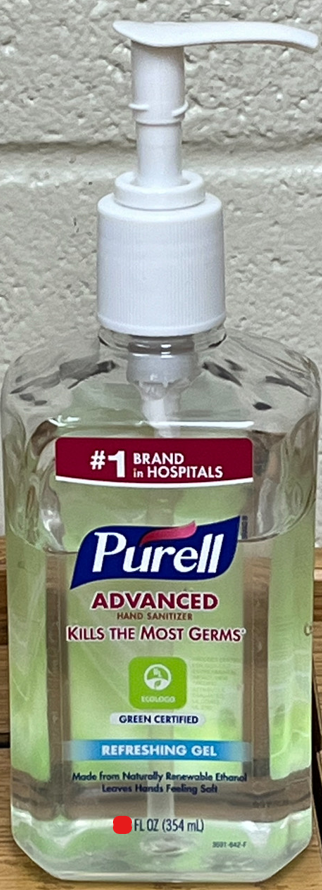
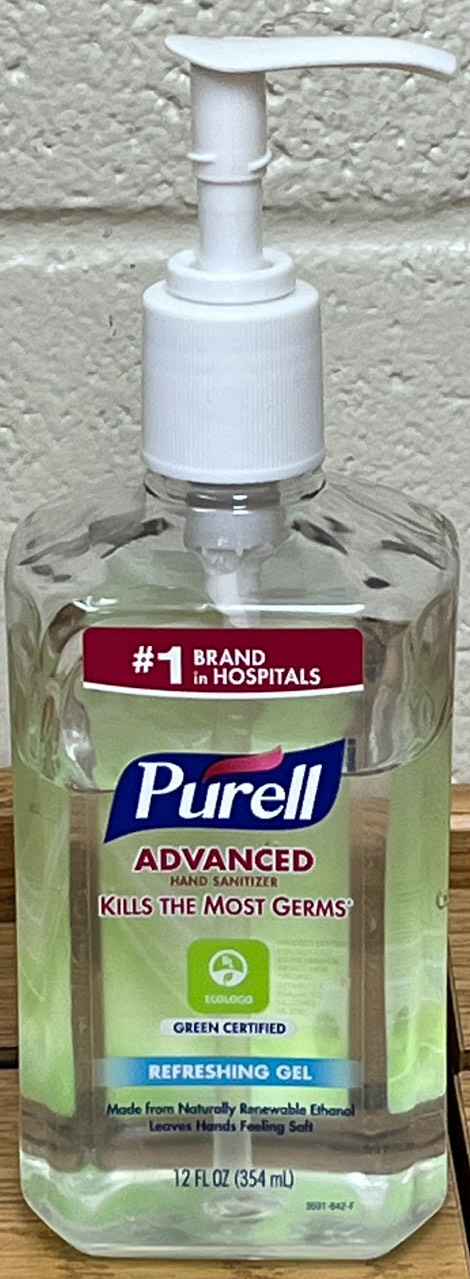
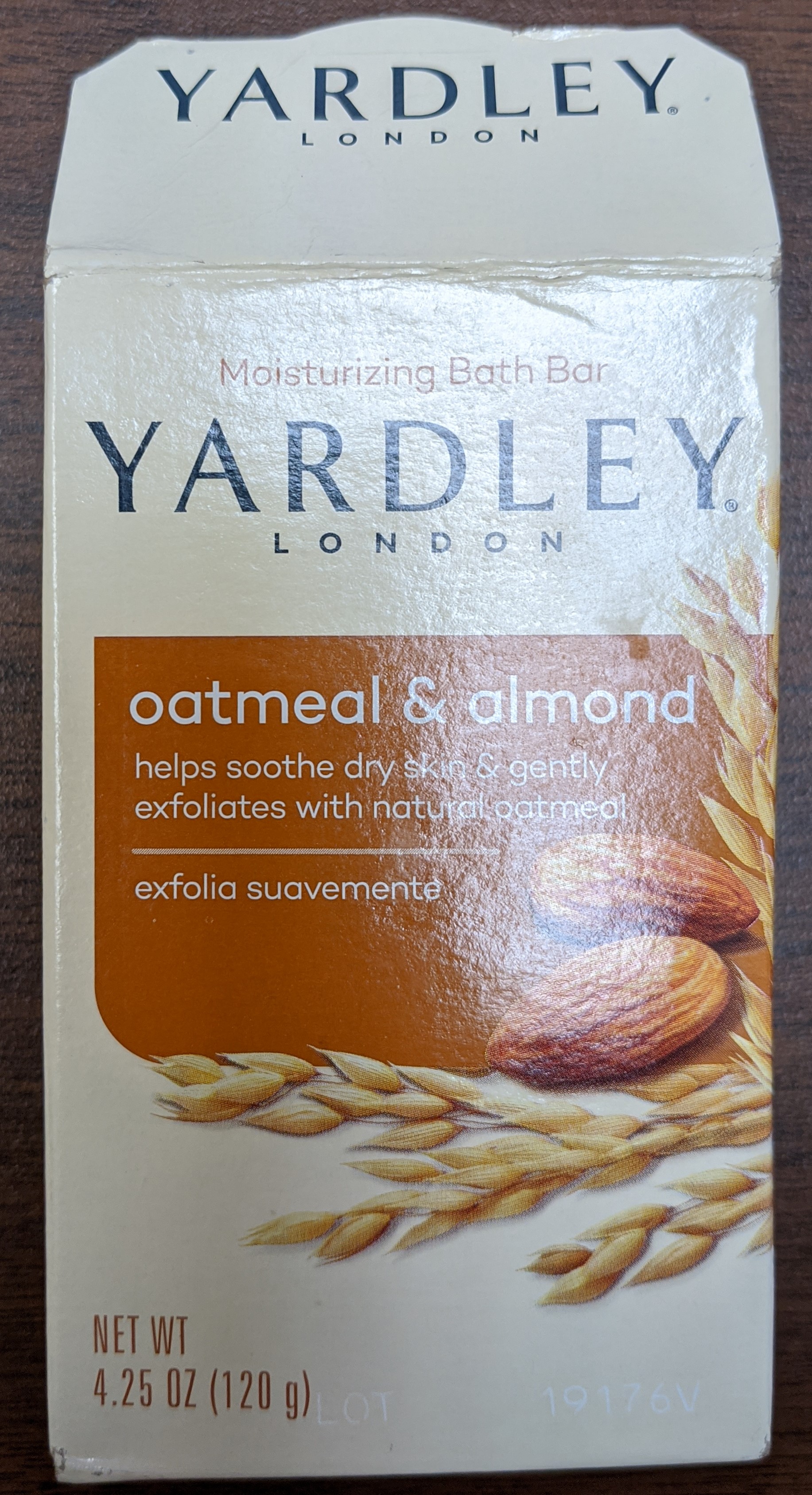
MTH 154: Quantitative Reasoning: Measurements and Units on Containers
Measurement: Mass
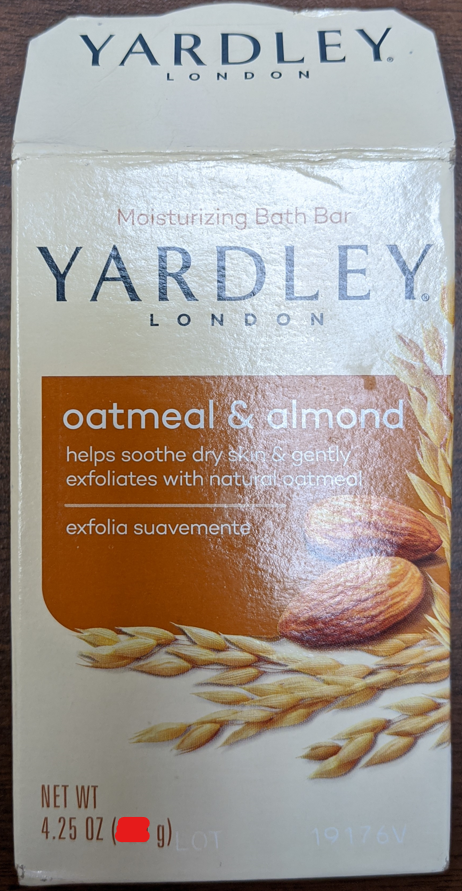
Using these conversions:
$
1\;lb = 16\; oz \\[3ex]
1\;lb = 453.59237\;g \\[3ex]
$
Calculate the missing measurement.
Do not round your answer.
$\text{Mass} = 120.485473\; \text{grams}$
(4.) Here's another one.
MTH 154: Quantitative Reasoning: Measurements and Units on Containers.
Measurement: Volume
Using these conversions:
$
1\;mL = 10^{-3}\;mL = 0.001\;L \\[3ex]
1\;L = 0.26417205\;gal \\[3ex]
1\;gal = 128\;fl.\;oz. \\[3ex]
$
Calculate the missing measurement.
Do not round your answer.
(5.) Still on MTH 154, but on a different topic.
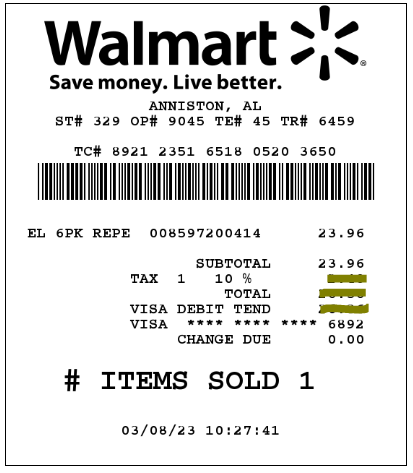
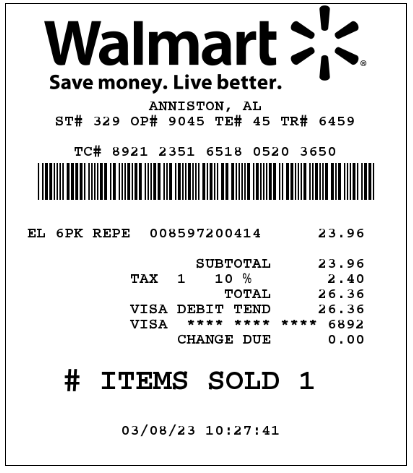
MTH 154: Quantitative Reasoning: Percent Application on Receipts
Case 1:Given: Initial price and Tax rate Calculate:
(a.) Tax
(b.) Total price
Do not round the intermediate values.
Do not round the final answers.
$
(a.) \\[3ex]
\text{Tax} = \$ 2.396 \\[3ex]
(b.) \\[3ex]
\text{Total price} = \$ 26.356 \\[3ex]
$
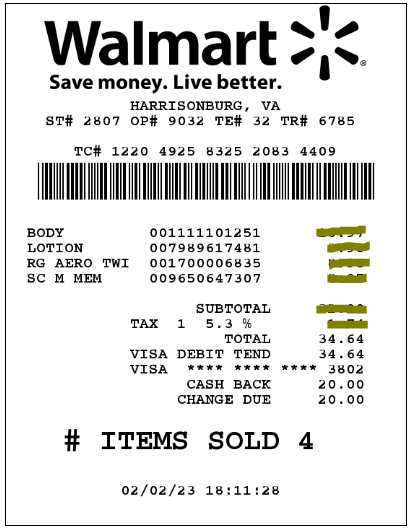
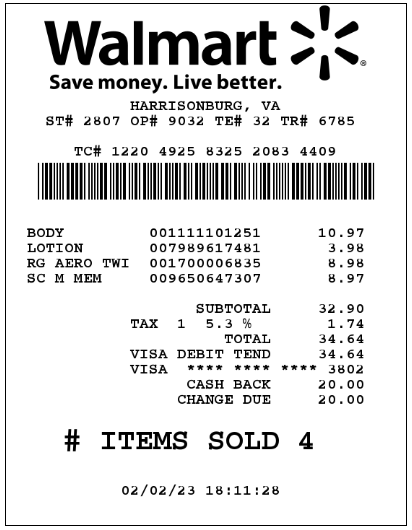
This is the original receipt.
(6.) Here's another one on a different concept.
MTH 154: Quantitative Reasoning: Percent Application on Receipts
Case 2:Given: Tax rate and Total price Calculate:
(a.) Initial price (Subtotal)
(b.) Tax
Do not round the intermediate values.
Do not round the final answers.
$
(a.) \\[3ex]
\text{Initial price} = \$ 32.89648623 \\[3ex]
(b.) \\[3ex]
\text{Tax} = \$ 1.74351377 \\[3ex]
$
This is the original receipt.